Wednesday, 25 March 2015

Reading women in 2014

This post has been trickier than I thought writing it would be. It's been on my 'must finish' list for quite some time now, but I've struggled to string together the words I've wanted to to express my thoughts. However, the time has come for me to bite the bullet and just finish off what I've started, because it's a topic I'm very passionate about and frankly, as Elizabeth Gilbert once said, done is better than spending an eternity perfecting something that you never get to share with anyone. So here I go.  

Artwork by Joanna Walsh

Last year I took on my first official reading challenge: the Australian Women Writers Challenge. The premise was to read and blog about as many Australian women writers in 2014. And in case you're wondering, yes I achieved my goals - huzzah!

My motivation stemmed from reading this article, which posed the question of why we don't read more books written by women. It was an idea that really resonated with me because it wasn't until reading it that I realised I could be reading more books by women. And it really troubled me that I wasn't, considering that I'm an Australian woman myself. So why wasn't I?


For starters, prior to the challenge I simply paid more attention to books by men. Why this was the case I'm not entirely sure - I suppose the fact that they're talked about publicly more is one reason (in fact, it was only last month that I received an email from a large Australian book-seller who didn't mention any Australian women in their recommended reading list, only mentioning Australia). As David Pritchard, who is the editor of an American journal which dedicated its 2014 reviews to women and writers of colour, says, "Women writers and writers of colour are underserved and undervalued by the contemporary community." So why is this the case?

The Cherchez la Femme podcast on 'Feminism and Girls' sheds some light on this. In it, Emily Maguire mentions that young children, particularly boys, are not expected to read stories with female protagonists in them (I'll discount fairy tales here, which young boys will be familiar with, because their portrayal of female protagonists is often problematic. By this I mean that the females in them are usually naive, helpless damsels who get themselves into trouble and can only be saved by men). Instead, books with female protagonists are considered 'girly' books, and reading them is somehow emasculating. This in turn silences the values and concerns of females. And yet in contrast, it is expected that young girls will read stories with either male or female protagonists unproblematically, meaning that they are exposed to the values and ideas of both genders more. 

How does this relate to devaluing female authors?

Well, I'd argue that this pattern towards not reading stories with female protagonists continues into adulthood, particularly among men. For some reason, it's still thought that reading books by and about women is only relevant for women, where such books are considered 'girly' and 'fluffy' and not worthy of anyone's serious time. Jodie Picoult agrees, having commented on the sexist nature of the publishing/bookselling industry regarding this very issue. Picoult's books, which deal with heavy topics ranging from the Holocaust to assisted dying, are rarely taken seriously. "I write women's fiction," Picoult says, "And women's fiction doesn't mean that's your audience. Unfortunately it means you have lady parts." Subsequently it means that women's writing is often devalued.

And yet, infuriatingly, Picoult points out that men authors, such as Nicholas Sparkes and Jeffrey Eugenides, get praise for writing what are mostly romance books. A genre that, when women contribute to it, gets written off as trashy 'chick lit' fiction. These double standards are part of the reason why reading more books by women is so important - so that we can hear and appreciate the value of stories by women in a world that often drowns their voices out.

Now, I'm not saying that all books by women should be read by both men and women, because frankly, as with any book, not all stories will be of interest to everyone. And to me, that wasn't the point of the reading women challenge. For me, its purpose was to broaden readers', as well as my own, horizons of the sorts of books they would consider worthy of reading, and to notice female authors more. This meant that I didn't solely read books by women last year, because for me, cutting out books by men entirely isn't the solution to this issue either: completely cutting out one group to make room for another is something I find problematic. Instead, strategies need to be put in place to ensure that those who might normally get unnoticed and drowned out don't; strategies similar to introducing workplace quotas to ensure that women aren't ignored when being considered for particular roles. This challenge was a type of quota exercise - I set the number of books authored by Australian women I wanted to read, and I achieved it.

So in the end my take home message is this: if you haven't done so already, challenge yourself to read more books by women, especially Australian women for all those Australians reading this. And set yourself a specific goal to make sure you actually do it. Because women's voices have been underrepresented for too long and they need to be given the value, support and recognition that they deserve. After all, they've got bloody good stories to tell.

Australian women's books I read in 2014

Read and reviewed
Bewitched and Bedevilled: Women Write the Gillard Years edited by Samantha Trenoweth
Night Games by Anna Krien
The Misogyny Factor by Anne Summers
Destroying the Joint: Why Women Have to Change the World edited by Jane Caro
Ducks on the Pond by Anne Summers
Only the Animals by Ceridwen Dovey
Class Act by Maxine McKew

Read only
By the Book: A Reader's Guide to Life by Ramona Koval
Unpolished Gem by Alice Pung
The Silver Donkey by Sonya Hartnett


Wednesday, 4 March 2015

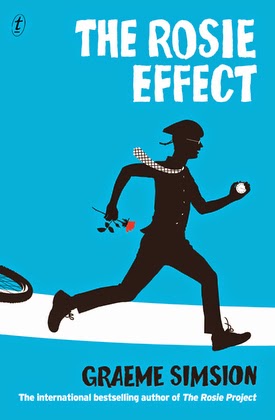
Review: The Rosie Effect, by Graeme Simsion

Before I get stuck into my review of The Rosie Effect, I very quickly want to comment on its predecessor, The Rosie Project. Because if I'm going to be honest, I have to admit that I didn't totally love it. While I thought Don was an excellent narrator and loved the perspective he provided to me as a reader, I did think the story itself was too predictable. And overly predictable stories are a pet-hate of mine. But perhaps that's what was needed in order to make Don's story more accessible to people reading it? Who knows?

Despite these minor grumbles I did like The Rosie Project enough to read it's sequel, The Rosie Effect. And this was anything but predictable. At a whopping 411 pages long, The Rosie Effect takes you on a whirlwind adventure as Don and Rosie are unexpectedly expecting their first baby in their first year of marriage. 

Most of the craziness that results is ironically due to Don trying to be more empathetic and considerate of others, which we as readers can certainly empathise with. After all, how many times have you done something because you think it's for the right reason, when really it has the opposite effect? Well, this is a phenomenon that Don becomes increasingly familiar with and fortunately as the reader you get to laugh and cringe at Don as he fumbles along trying to do the right thing by those he cares for
.

It's this growth in Don - where he is more considerate and caring of how his actions effect those closest to him - that I really enjoyed in The Rosie Effect. After all, Don is the most unlikely person to start a men's support group, learn the ins and outs of fatherhood and bring together broken families. And yet he gets himself into all of these scenarios without realising the (unintentionally) positive effects he is having on others. As the fortunate reader you get to go on this journey with Don, who despite helping others, still finds much human behaviour utterly confusing and unpredictable. And thus Don reminds us that this is a wonderfully fundamental part of being human, making it easier for us as readers to connect with him and see the world from his perspective.


But it's not all happy-go-lucky for Don and Rosie, who face their own relationship challenges as they both adjust to the realisation of becoming parents. Simsion's portrayal of the daunting prospect of becoming parents is both touching and unnerving, particularly due to Don and Rosie's different approaches to coping with the upcoming changes. 

Overall The Rosie Effect is a great read and a great sequel to what was such a hit of a first book. It's very funny and very entertaining and has a lot of heart.


Tuesday, 10 February 2015

Reviews: What I read this summer

I love summer. I love the (mostly) warm weather with blue-sky days. I love that I get to go on holidays. I love that the days are longer. And I love that I get to wear summer dresses. But mostly I love the fact that I get more time to do one of my favourite things in the whole entire world. Which, you probably won't be surprised to know, is reading lots.

This summer I read everything from confirmed and unconfirmed autobiographies, to books about relationships, education and Australian politics. So here are my thoughts on the books I read over summer. What did you read?


Yes Please, by Amy Poehler

There's no other way for me to start this other than to say that Amy Poehler is a complete babe. She's just so sassy and so self-assured, yet she also gives you the impression that she wears her heart on her sleeve. Who wouldn't warm to that sort of person?

In Yes Please, Poehler discusses how she got to where she is in her career today (she worked really hard); talks about being a single mother (it can be really hard); and comments lots on the process of writing a memoir (it's really hard). Yet even though she has worked very hard, what becomes evident is that she does not shy away from challenges - in fact, she embraces them.

Unlike with other memoirs, it's sometimes hard to tell whether Poehler is being truthful or tongue-in-cheek. Which I kind of like, because it keeps you guessing about who the 'real' Amy Poehler is. However the flipside of this is that you end up feeling like you might not actually know Poehler any better after reading her memoir; as if everything in the book is calculated to present a certain image of herself. Which no doubt all memoirs are in some way - it's just that it was a bit more obvious for me in this one than others have been. 

Nevertheless Poehler's can-do, let's-say-yes-and-get-down-and-dirty approach to everything is so inspiring that it makes you want to fist-pump the air and say, 'Yeah, I can do whatever I set my mind to too!' after reading it.

My favourite quotes? 
'Nobody looks stupid when they are having fun.'
'Change is inevitable, get used to it, so just ride the wave.'  
'It takes years as a woman to unlearn what you have been taught to be sorry for. It takes years to find your voice and seize your real estate.'
Poehler has certainly seized her real estate and her memoir is clear evidence of this, despite me being hungry for more.


Class Act, by Maxine McKew

Class Act is an insightful look at how some of Australia's leading schools have achieved being the best schools our country can offer our students. It's a celebration of their achievements, focusing on a handful of schools from all over the country and their leaders who have taken a stand to create positive change.

As someone who is studying teaching it was a really engaging read, exploring many key ideas discussed in my course, such as: how well are we preparing students to cope in a world that increasingly requires them to adapt and use their initiative; the importance of lifting the bar of what's expected and accepted of students at school; and the importance of giving all students access to a rich variety of subjects and resources - not just those who can afford it.

It's always refreshing to see how some of these concepts, which are usually discussed in theory, have been successfully implemented by key change-makers at the schools included in Class Act. What's even more refreshing to read is how many of these schools have beaten the odds in some way to achieve more than what the community thought they and their students were capable of.

My favourite quote?
'If we don't do everything we can to develop the full potential of these children, then the loss to our society it criminal' - interview with John Farrell, Principal of Our Lady of Mount Carmel Primary School, Sydney, who has embraced high expectations for all of his students, many of who are Indigenous.


Us, by David Nicholls

This is the story of Douglas and Connie, a couple who have been married for twenty-odd years. Their only son, Albie, is about to go to college, and Connie has come to the realisation that she no longer wants to be married to Douglas. This comes as a shock to Douglas, though as the narrative unfolds it becomes more and more evident that there were signs of cracks in their relationship for some time.

Nevertheless Douglas and Connie decide to go on one last trip to Europe together with Albie, who is unsurprisingly reluctant to be dragged along with his clearly unhappy parents. And so the narrative largely focuses on this family's trip in Europe and David's misguided attempts to keep his family together. It also flashes back to when Douglas and Connie first met and what initially drew them together, which I particularly enjoyed reading (I'm a big fan of flashbacks!).

Though all of this might sound cliched and dull (which is what I would have thought had I not seen Nicholls authored it), it's a touching account of a marriage on the decline and what happens when you grow apart from the person you fell in love with and married. So often relationship stories end with the protagonist securing his/her true love, where you're simply left to assume that they'll live happily ever after. Us offers a different narrative.

At times wickedly funny, at others dispiritingly unsettling, Nicholls has created a memorable story with vivid characters that you'll both love and want to strangle.


My Story, by Julia Gillard 

I was really looking forward to this one. Ever since Gillard was horribly mistreated as Prime Minister, I've wanted to know more about this woman who put up with so much disrespect yet didn't let it stop her from achieving so much in her short term as PM. My Story is a thorough account of these achievements, detailing the reasons for many of the policies Gillard's government introduced. It's unfortunate that politicians don't get more of an opportunity to explain their positions while in office, and Gillard's book certainly highlights how petty and embarrassing the reporting of politics is in Australia given how many important changes were actually happening throughout her leadership.

It's unsurprising that Gillard's book also touches on her professional relationship with Kevin Rudd and it's eventual demise, though she does so tactfully and respectfully. She's also happy to admit her flaws, particularly the lack of effectively communicating the Labor leadership change and carbon price to the Australian people. 

Gillard also delves into her mistreatment as Australia's first female Prime Minister. This was the part of the book I was most interested in, as it was Gillard's mistreatment as Prime Minister which initially re-ignited my interest in feminism. While Gillard doesn't convey that she is bitter about what happened, she rightly still questions why more people, particularly men of influence outside of politics, didn't stand up for her and call out more people on their sexism to send the public a message that such disgusting behaviours would not be tolerated. And when she documents just how highly she was scrutinised as a woman Prime Minister - everything from what she wore to her relationship with her partner (subjects that are irrelevant for male politicians) - it's truly alarming that this was happening only a year and a bit ago.

While at times Gillard does let her guard down (for example providing humorous anecdotes about her partner Tim), for the most part her book felt quite reserved and lacked a sense of getting to know Gillard better personally, which is what I was (perhaps erroneously) expecting. But I've not read another politician's biography before so perhaps this is the norm? Or perhaps that was the intention? 

The following line, which is the last one from Gillard's memoir, sums up the book perfectly:
'I hope [this book has]...helped you see not only the world I lived in as prime minster but the vision of our nation I was working towards. Stronger and fairer.' 
My Story certainly had this outcome for me, despite my disappointments with the book. But it is Gillard's story after all, a woman who has had her fair share of being told how she should behave and communicate.


Go Ask Alice, Anonymous

This was a book a friend recommended I read. In fact, she leant me her copy, which had previously been her mother's, which made it an extra special reading experience. It's so fun reading books that are owned by others and thinking about what other adventures and walks of life they've been on, especially when the books themselves are as influential as Go Ask Alice is.

Published in 1971, Go Ask Alice is the story of an anonymous protagonist who inadvertently becomes involved with and subsequently addicted to drugs. The origins and authenticity of this book are still unclear, which adds to its mystery and allure.

It's a story about teenage angst, about the hopelessness of feeling like you don't quite belong anywhere, and about the need to properly talk about and support those who are showing signs that they are slipping away from us. It's a book that will tug at your heartstrings and make you question just how far we as a society have really come in supporting those who need our help the most. All of these themes make Go Ask Alice such a timeless and powerful read.


Wednesday, 31 December 2014

Review: Only the Animals, by Ceridwen Dovey

There's a quote by Robin Williams' character in the movie August Rush which is, 'You know what music is? God's little reminder that there's something else besides us in the universe; harmonic connection between all living beings, everywhere, even the stars.' I came across this quote accidentally after reading Dovey's Only the Animals, and when I read it I thought it encapsulated how I felt about the book perfectly: it's a beautiful reminder that there is a connection between all things in this world which should be celebrated more.

Only the Animals is written from the perspective of animals who have been killed as a result of human conflict throughout the twentieth century; ranging from World Wars I and II to the Cold War to the 2006 bombing of Beirut. The animals, who each have a chapter devoted to them, also pay tribute to writers who wrote about animals in their career; from Leo Tolstoy to Virginia Wolf to Sylvia Plath. The result is an intricately woven collection of stories which are part imaginative mastery and part a timely reminder that humans have much to learn from animals.

It's this latter point that has pleasantly surprised me the more I read stories centred around animals (Martel's Life of Pi and Beatrice and Virgil are others). And the reason for this, which Dovey cleverly includes in her own book, is that there is sometimes 'no way [for humans] to say what...[should be said]...except by making that animal speak for them.' 

Thus on a number of occasions while reading this book, I was awed by the sheer power of the perspective an animal  provided. And while a human could just as easily have said these words, there's something curious and enigmatic about why they were particularly powerful because they were uttered by an animal. It's these sorts thoughts which Only the Animals spurred for me that I really loved.

I'll indulge myself now and add in my favourite quote from the book, which, once you've read it, may ironically not resonate with you at all. This quote is spoken by a turtle who grows up living with the Tolstoy family in Russia, is shipped to the UK to live with Viriginia Wolf, and finally ends up involved in the Space Race in the USA. Here the turtle is reflecting on the time he has spent discussing books with Tolstoy's daughter:

'I am aware that one person's insights and epiphanies from unique reading journeys are not always interesting to another, just as other people's tales about their travels mostly inspire boredom. I've wondered why this is for humans, and I've decided it has something to do with the perceived alchemical magic of the discoveries that books (or travel) enable: they are utterly private and idiosyncratic, and, to the person undergoing them, feel ordained, auspicious, designed especially for them at that particular moment in their lives. In a century during which many people have lost the religious framework of fatalism, it seems books have become signs to interpret and follow - this book has come into my life for a reason, the author is speaking to me and to me alone. And this, in a strange way, leads to people becoming evangelical about books. You must read this, they preach, forgetting that it was the way they stumbled serendipitously upon the book - finding it abandoned on the seat of a couch, or dusty in the attic, or neglected in a dark stack in the library - that was partially responsible for its powers.'

As I've already alluded to, this quote may not resonate with you at all, and I can appreciate the irony of it being used in a book review; after all the latter is a forum used to recommend books to you, which the turtle suggests is meaningless to everyone but the reader. Nevertheless, for me it captures the philosophical nature of the book and how well Dovey writes. And, fortunately for the reader, there's many more such thought-provoking quotes within her book.

Regardless of how you feel about book reviews, Only the Animals is an absolute treasure of a book to read and it will undoubtedly take you on an incredibly unique and enchanting reading journey.


Tuesday, 23 December 2014

Review: One More Thing, by B.J. Novak

Sometimes I have bizarre dreams. Like the one where a guinea pig came to my workplace and started rollerskating down our corridor (don't worry, he was safe because he wore a helmet and elbow pads). Or the one where I was an astronaut being shot into outer space, though I was so scared during lift off that I passed out for most of the trip and only came to when I returned to Earth, only remembering the part where I got to push the big red 'take-off' button (that bit was thrilling). Or the one where Brad Pitt sat next to me at a show we were both at and when I accidentally bumped his knee I casually said 'excuse me' as if he was just a normal person even though I was totally excited that I was sitting next to Brad Pitt and had just brushed his knee (I played it so cool).

Well, One More Thing is kind of like these dreams of mine in that their content is quite random and will catch you off-guard, except it'll probably entertain you more. It's a collection of short stories written by B.J. Novak, the American actor, stand-up comedian, screenwriter, author, and director, who is most widely known for writing, co-executive producing and acting in The Office. The stories range from the re-telling of well-known tales (such as the story of a re-match between the tortoise and the hare) to original Novak-ian stories.

If you want to be highly amused and simultaneously have your appropriateness boundaries tested, then this is the perfect book for you. Take, for example, the story of the lady who goes on a date with a warlord. In it, the lady casually asks the warlord what's involved with being a warlord, and the warlord casually discusses how his job entails the occasional rape and murder of innocent civilians. While I'm open to hearing different perspectives of people offered in books, the casual off-handed way these serious topics are handled in this particular story really shocked me. But not in a way that made me want to stop reading the book (though I did consider it); rather I was impressed with Novak's gutsiness at writing about such taboo topics in the ways he does.

But it's not all 'let's push the boundaries and see how far I can test readers' reading; there are some really heartwarming stories in it too. Like the story of a man who dies and is reunited with his already deceased wife in heaven. The reunited couple fall in love all over again and go on some amazing adventures together, all of which take place in heaven. How lovely is that!?

One More Thing a great book for that friend who likes weird, twisted things, and/or the friend who likes to be challenged with the types of stories they read. The stories are not only entertaining because of their content, but also because of the way Novak has told them, with plenty of clever wordplay in it too.

It's bizarre, it's strange, it's very entertaining and it's definitely worth a read if anything I've just mentioned has intrigued you. DO IT.


Read more: http://bloggerknown.blogspot.com/2013/02/changing-blog-page-by-page-number.html#ixzz2mUXnF3wj