Showing posts with label australian women writers challenge. Show all posts

Wednesday, 25 March 2015

Reading women in 2014

This post has been trickier than I thought writing it would be. It's been on my 'must finish' list for quite some time now, but I've struggled to string together the words I've wanted to to express my thoughts. However, the time has come for me to bite the bullet and just finish off what I've started, because it's a topic I'm very passionate about and frankly, as Elizabeth Gilbert once said, done is better than spending an eternity perfecting something that you never get to share with anyone. So here I go.  

Artwork by Joanna Walsh

Last year I took on my first official reading challenge: the Australian Women Writers Challenge. The premise was to read and blog about as many Australian women writers in 2014. And in case you're wondering, yes I achieved my goals - huzzah!

My motivation stemmed from reading this article, which posed the question of why we don't read more books written by women. It was an idea that really resonated with me because it wasn't until reading it that I realised I could be reading more books by women. And it really troubled me that I wasn't, considering that I'm an Australian woman myself. So why wasn't I?


For starters, prior to the challenge I simply paid more attention to books by men. Why this was the case I'm not entirely sure - I suppose the fact that they're talked about publicly more is one reason (in fact, it was only last month that I received an email from a large Australian book-seller who didn't mention any Australian women in their recommended reading list, only mentioning Australia). As David Pritchard, who is the editor of an American journal which dedicated its 2014 reviews to women and writers of colour, says, "Women writers and writers of colour are underserved and undervalued by the contemporary community." So why is this the case?

The Cherchez la Femme podcast on 'Feminism and Girls' sheds some light on this. In it, Emily Maguire mentions that young children, particularly boys, are not expected to read stories with female protagonists in them (I'll discount fairy tales here, which young boys will be familiar with, because their portrayal of female protagonists is often problematic. By this I mean that the females in them are usually naive, helpless damsels who get themselves into trouble and can only be saved by men). Instead, books with female protagonists are considered 'girly' books, and reading them is somehow emasculating. This in turn silences the values and concerns of females. And yet in contrast, it is expected that young girls will read stories with either male or female protagonists unproblematically, meaning that they are exposed to the values and ideas of both genders more. 

How does this relate to devaluing female authors?

Well, I'd argue that this pattern towards not reading stories with female protagonists continues into adulthood, particularly among men. For some reason, it's still thought that reading books by and about women is only relevant for women, where such books are considered 'girly' and 'fluffy' and not worthy of anyone's serious time. Jodie Picoult agrees, having commented on the sexist nature of the publishing/bookselling industry regarding this very issue. Picoult's books, which deal with heavy topics ranging from the Holocaust to assisted dying, are rarely taken seriously. "I write women's fiction," Picoult says, "And women's fiction doesn't mean that's your audience. Unfortunately it means you have lady parts." Subsequently it means that women's writing is often devalued.

And yet, infuriatingly, Picoult points out that men authors, such as Nicholas Sparkes and Jeffrey Eugenides, get praise for writing what are mostly romance books. A genre that, when women contribute to it, gets written off as trashy 'chick lit' fiction. These double standards are part of the reason why reading more books by women is so important - so that we can hear and appreciate the value of stories by women in a world that often drowns their voices out.

Now, I'm not saying that all books by women should be read by both men and women, because frankly, as with any book, not all stories will be of interest to everyone. And to me, that wasn't the point of the reading women challenge. For me, its purpose was to broaden readers', as well as my own, horizons of the sorts of books they would consider worthy of reading, and to notice female authors more. This meant that I didn't solely read books by women last year, because for me, cutting out books by men entirely isn't the solution to this issue either: completely cutting out one group to make room for another is something I find problematic. Instead, strategies need to be put in place to ensure that those who might normally get unnoticed and drowned out don't; strategies similar to introducing workplace quotas to ensure that women aren't ignored when being considered for particular roles. This challenge was a type of quota exercise - I set the number of books authored by Australian women I wanted to read, and I achieved it.

So in the end my take home message is this: if you haven't done so already, challenge yourself to read more books by women, especially Australian women for all those Australians reading this. And set yourself a specific goal to make sure you actually do it. Because women's voices have been underrepresented for too long and they need to be given the value, support and recognition that they deserve. After all, they've got bloody good stories to tell.

Australian women's books I read in 2014

Read and reviewed
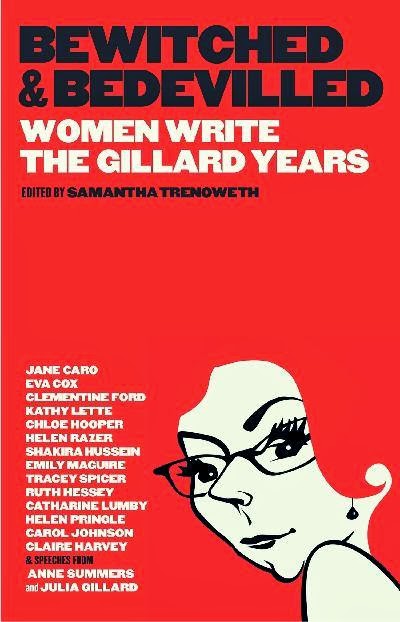
Bewitched and Bedevilled: Women Write the Gillard Years edited by Samantha Trenoweth
Night Games by Anna Krien
The Misogyny Factor by Anne Summers
Destroying the Joint: Why Women Have to Change the World edited by Jane Caro
Ducks on the Pond by Anne Summers
Only the Animals by Ceridwen Dovey
Class Act by Maxine McKew

Read only
By the Book: A Reader's Guide to Life by Ramona Koval
Unpolished Gem by Alice Pung
The Silver Donkey by Sonya Hartnett


Wednesday, 31 December 2014

Review: Only the Animals, by Ceridwen Dovey

There's a quote by Robin Williams' character in the movie August Rush which is, 'You know what music is? God's little reminder that there's something else besides us in the universe; harmonic connection between all living beings, everywhere, even the stars.' I came across this quote accidentally after reading Dovey's Only the Animals, and when I read it I thought it encapsulated how I felt about the book perfectly: it's a beautiful reminder that there is a connection between all things in this world which should be celebrated more.

Only the Animals is written from the perspective of animals who have been killed as a result of human conflict throughout the twentieth century; ranging from World Wars I and II to the Cold War to the 2006 bombing of Beirut. The animals, who each have a chapter devoted to them, also pay tribute to writers who wrote about animals in their career; from Leo Tolstoy to Virginia Wolf to Sylvia Plath. The result is an intricately woven collection of stories which are part imaginative mastery and part a timely reminder that humans have much to learn from animals.

It's this latter point that has pleasantly surprised me the more I read stories centred around animals (Martel's Life of Pi and Beatrice and Virgil are others). And the reason for this, which Dovey cleverly includes in her own book, is that there is sometimes 'no way [for humans] to say what...[should be said]...except by making that animal speak for them.' 

Thus on a number of occasions while reading this book, I was awed by the sheer power of the perspective an animal  provided. And while a human could just as easily have said these words, there's something curious and enigmatic about why they were particularly powerful because they were uttered by an animal. It's these sorts thoughts which Only the Animals spurred for me that I really loved.

I'll indulge myself now and add in my favourite quote from the book, which, once you've read it, may ironically not resonate with you at all. This quote is spoken by a turtle who grows up living with the Tolstoy family in Russia, is shipped to the UK to live with Viriginia Wolf, and finally ends up involved in the Space Race in the USA. Here the turtle is reflecting on the time he has spent discussing books with Tolstoy's daughter:

'I am aware that one person's insights and epiphanies from unique reading journeys are not always interesting to another, just as other people's tales about their travels mostly inspire boredom. I've wondered why this is for humans, and I've decided it has something to do with the perceived alchemical magic of the discoveries that books (or travel) enable: they are utterly private and idiosyncratic, and, to the person undergoing them, feel ordained, auspicious, designed especially for them at that particular moment in their lives. In a century during which many people have lost the religious framework of fatalism, it seems books have become signs to interpret and follow - this book has come into my life for a reason, the author is speaking to me and to me alone. And this, in a strange way, leads to people becoming evangelical about books. You must read this, they preach, forgetting that it was the way they stumbled serendipitously upon the book - finding it abandoned on the seat of a couch, or dusty in the attic, or neglected in a dark stack in the library - that was partially responsible for its powers.'

As I've already alluded to, this quote may not resonate with you at all, and I can appreciate the irony of it being used in a book review; after all the latter is a forum used to recommend books to you, which the turtle suggests is meaningless to everyone but the reader. Nevertheless, for me it captures the philosophical nature of the book and how well Dovey writes. And, fortunately for the reader, there's many more such thought-provoking quotes within her book.

Regardless of how you feel about book reviews, Only the Animals is an absolute treasure of a book to read and it will undoubtedly take you on an incredibly unique and enchanting reading journey.


Tuesday, 19 August 2014

Review: Ducks on the Pond, by Anne Summers

I recently read an interview by Eleanor Catton, Booker Prize winning author of The Luminaries. In the interview, Catton explains the uniqueness of novels compared to other art-forms, saying that when you read a good novel, your mind and body become so wholeheartedly drawn into it that the experience is an all-encompassing one for the reader. Nothing going on around you matters, and you want to do all you can to stay in and continue experiencing the world that's being presented to you by the author.

This all-encompassing phenomenon is one I'm familiar with. And it's one that I experienced while reading Anne Summers' remarkable autobiography, Ducks on the Pond. For those of you who don't know, Summers is an esteemed Australian writer and journalist, best known for her involvement in feminist writing, editing and publishing; including The Misogyny Factor. It was actually after reading The Misogyny Factor that I wanted to learn more about Summers, and this is how I came across Ducks on the Pond. And it didn't disappoint. Set from Summers' birth in 1945 up until 1976, I felt like I was completely transported into her world and living a double life while reading it. 


Now you may be thinking - 30 years, that's an awfully short span for an interesting autobiography. Right? Wrong. Summers' numerous achievements during that relatively short amount of time is positively astounding. From becoming heavily involved in the Australian Women's Movement in the 1970s, to opening one of the first women's-only refuges in Australia, to publishing her first book (the controversially titled Damned Whores and God's Police), it's hard to believe that Summers achieved all that she did in that little time.

However, it wasn't an easy journey. Summers' recounts growing up in the oppressively conservative era of the 1950s, where 'there were only three things a woman could do: get married and have kids, become a nun or end up an old spinster' (p.69). She details the disillusion of having to select a pathway based on these rigid archetypes, as well as the various conflicts she faced when she did not meet the expectations of her strongly Catholic family. Summers eventually left home to pursue a more liberating life, facing many challenges along the way in a world which did not support independent women. 

But while Summers did face some tough, and at times distressing, challenges, she also recounts the happier times, such as what it was like growing up during the thrilling 1960s. This was one of my favourite sections of the book, namely because the 1960s is one of my favourite eras of history, and one which I would have loved to have grown up in myself. Reading Summers' vivid accounts of going to the concerts of Bob Dylan and first discovering the music of The Beatles, Janis Joplin, Jimi Hendrix, Led Zeppelin and Jim Morrison and the Doors was riveting - as if I had stepped back in time and was reliving it all with her. Summers captures the novelty and excitement of this era brilliantly, building up to the new ways society would re-think the social roles of men and women in the coming decade, where, to paraphrase Bob Dylan, the times they were a changin'.

Still, Summers doesn't try to gloss over how difficult it was to instigate change during this time. In this way Ducks on the Pond shed a new light on this era for me, by detailing how difficult it was for people to make changes. It can often be easy to get caught up in the excitement of the 1970s and how much change was happening then, while forgetting that there was still plenty of strong resistance against the causes people were fighting for. Nevertheless, reading about the sheer resilience and admirable persistence of Summers and her allies was inspiring and fascinating, making me question just how much effort people are willing to go to nowadays to protest against unjust causes. 

Overall Ducks on the Pond is the extraordinary story of how one woman refused to let the cultural and social boundaries of the time dictate what she could achieve. For it was Summers' firm belief in the right for women to be the subjects of their own lives which was the driving force behind so many of her actions. Summers herself realises how fortunate her life has been, largely attributing it to the power of education in freeing her. For, with education Summers says, 'I learned it was possible to have big dreams and bold ambitions. I could make my own life, and I would' (p.143). It's a fascinating, inspiring and powerful account of growing up in mid-century modern Australia, and is an Australian Story that deserves to be more widely read.

Tuesday, 29 July 2014

Review: Destroying the Joint, edited by Jane Caro

The catalyst for the collection of essays that is Destroying the Joint: Why Women Have to Change the World was a comment made in 2012 by a male radio shock jock. I'm not going to mention his name - even though some of you may already know it - but I will tell you about the comment since it did set the context for this book. 

The comment was made in relation to the then Prime Minister Julia Gillard's intentions to donate money to women in the Pacific for the development of their leadership skills. This shock jock claimed that women were doing enough damage in the world already - specifically naming ex-Victorian Police Commissioner Christine Nixon and lord mayor of Sydney Clover Moore as examples - so surely we needn't be giving more leadership opportunities to women. In fact, women were doing so much damage in the world that they were 'destroying the joint', thus laying fame to this phrase. 

A cheeky tweet by Jane Caro in response to this shock jock's comment - 'Got time on my hands tonight so thought I'd come up with new ways to destroy the joint, being a woman and all. Ideas welcome.' - led to an unprecedented national response from women who were very much angry/disgusted/exasperated that such comments were (and still are) being made about them publicly in 2012. The women involved decided to unite, and so the Destroy the Joint campaign was born.

Thus the essays in Destroying the Joint are in response to this very notion of women 'destroying the joint'. They provide a variety of angles on this idea, such as whether or not women are actually in 'the joint'; whose joint it is that we are/are not destroying; who has a right to say whether or not we are destroying the joint; and, if we accept that we are destroying the joint - as this doesn't have to be a negative thing - whether or not we should take more pride of destroying it.

Written from political, social, environmental, creative, educational and disability perspectives, Destroying the Joint provides a variety of lenses through which this issue can be viewed through, as well as how it relates to wider feminist issues. The way the essays are written make it very accessible for those curious to learn more about feminism and it's vast scope. For me, they provided a solid introduction into avenues of feminism I'd like to pursue further.

I guess my next question with a book like this is how to keep the conversation going? And how do we start including people that might not normally pick up a book like this so that they can enter and be part of this conversation? Because I believe that's so important if we do want more action to take place to help feminist messages spread and start having more of an impact on everyday life for women and men. Now, I don't quite know the answer to this question I have posed, but I do know that I want to keep engaging in these issues and conversations so that change can become more of a reality.

I'll finish off by including some cracking quotes from the contributors to Destroying the Joint so that you can get a taste of this fantastic collection of essays. 

Michelle Law:
'Being a feminist is not about despising men, or overtaking them...Feminism is about despising an idea. And the idea is that women are unequal to men. It is that they deserve or should expect the kind of sexism, misogyny and mistreatment that they receive. It is that any women who rejects this treatment will be met with aggressive, irrational and sometimes unintelligible scorn. When we are destroying the joint, we are calling out sexism and misogyny.'

Catherine Deveney:
'The truth is, there is not one feminism, but many feminisms. And just because you are pro woman does not mean you are anti men. I think one of the main reasons I am a feminist is because I love boys and men so much and I have hated the way society has expected them to live, love and be. Feminism is not anti men. It's anti arseholes, misogynists, pricks, creeps, thugs and bigots.'

Senator Penny Wong
'We live in the same Australia, we share many values, but our experiences and therefore our perceptions of reality can be so different. If we are to understand across these differences, we have to be capable of more than tolerance. We have to try to imagine another's experience and to do so with imagination, compassion and respect.'

Overall, Destroying the Joint is very much an informative, refreshing and entertaining insight into current Australian feminism and one which I very much recommend.

Want more?

Keep engaged in the conversation by following the Destroy the Joint community on Facebook or Twitter.

I've also recently discovered Cherchez la Femme, a fantastically entertaining and engaging feminist podcast that I also highly recommend you check out.


Tuesday, 8 July 2014

Review: Night Games, by Anna Krien

I have to admit, football is not my favourite topic to talk about, let alone read about. But in saying that, the particular culture it tends to promote - that being a highly masculine world where players are given an almost god-like status - is still one that I find somewhat fascinating, perplexing and at times disturbing. So when I discovered Anna Krien's Night Games, I was hoping to get an insight into these issues of sex, power and sport that have intrigued me.

Night Games follows a rape trial involving the Collingwood Football Club in the aftermath of the 2010 Grand Final against St. Kilda. Krien uses this trial as a lens to explore society's attitudes towards rape; gender and power imbalances in male-dominated sports; and how problematic it is that these attitudes remain accepted in everyday culture. It's like Krien has held up a giant mirror panel through which the trial is originally refelcted in, dropped it so it shatters, and then we the readers are left to pick up the pieces and put it back together again. Though each time we pick up a piece, our own images are reflected in the pieces themselves, reminding us that our own ideas and experiences will always influence how we view particular scenarios. The glass piece itself is never perfectly whole again either - lines from where the pieces join up are still evident so that the original scenario can never be viewed in the same way again; and some of the pieces have gone missing so that we can never truly know the full story. 


That's what reading Night Games is like, with Krien highlighting how fragmentary trials, particularly rape ones, can be, and how many shades of grey are involved with trying to understand the act of rape itself and the actions of the people directly involved. It's what I most enjoyed about reading Night Games, with the shades of grey Krien gutsily explores extending to attitudes towards sex and power in sport. It's very risky territory and Krien is very aware of this herself, stating, 'You've got the rapist or the liar...and by trying to seek out a shade of grey I'm protecting one of them' (p.258). She goes on to state:
'It is as if there's a fear that venturing into a grey area to discuss the complexities of consent and rape will unravel some forty years of feminist spadework, that people will be unnecessarily confused by any such discussion. But surely feminism isn't that fragile. And isn't it obvious that people are already confused? For despite the law being clear on the definition of consent, neither the police nor the public prosecutors seem to have much faith in a jury's ability to convict in certain cases, even if they do satisfy the legal criteria.' (p.259)

Thus, this very issue of how to delve into these shades of grey is a central theme of Night Games. The issues that unravel are many, including, but not limited to ideas that:

  • Thinking a women is asking for it when drunk can be just as bad as thinking all footballers are badly behaved jocks and potential rapists. 
  • AFL is one of the few male-only sports codes in the world that boast a large proportion of female supporters. Yet the gender and power imbalances are still so vast. Why? 
  • Are football 'groupies' complicit in promoting rape culture? Or are they examples of sexually empowered women?
  • Boys, as well as women, are used, abused and discarded in football, though obviously in very different ways.

Krien is so well read and justifies the positions she offers with such clarity and conviction that as a reader you feel that she is representing the issues in a very fair and honest manner.

Night Games, as Krien states towards the end of the book, is not anti-sport. After all, not all footballers, let alone sportsmen, treat the people they interact with poorly. But what needs to change is the 'men who use sport as power and the people - teammates, fans, coaches clubs, doctors, police, journalists, groupies - who let them do whatever they want.' Night Games is one gripping insight into this complex, multifaceted world, and has allowed me to begin seeing the shades of grey where I once didn't. 


Wednesday, 4 June 2014

Review: The Misogyny Factor, by Anne Summers

The 1970s were an extraordinary time for women. Finally, they were speaking out and taking action for matters that were specific and important to women; letting society know that how they were being treated was not ok. 

Fast-forward forty years later to 2012. Australia has its first female Prime Minister, a female Governor General, as well as a number of female MPs. While this progress is something to be proud of to some extent, how far has Australia really succeeded in terms of women's issues since the 1970s? That's the question Summers explores in The Misogyny Factor.


Summers begins with the matter-of-fact statement that despite the aforementioned 'achievements' of women, the state of women's affairs in Australia is little to gloat about. Sure, more women are in positions of leadership than ever before, but to what extent does that reflect society's acceptance and support of women in these positions? Just how inclusive is Australian society of women, particularly in terms of workplace involvement?

Not very, argues Summers. After all women's workforce participation, disparities in pay, the little number of women in senior company positions (which in Australia happen to be some of the lowest in the developed world for ASX listed companies), and domestic violence are all still issues affecting women despite four decades of attempts for change. In other words, the misogyny factor, which is the 'set of attitudes and entrenched practices that are embedded in most of our major institutions...that stand in the way of women being included, treated equally and accorded equally,' needs to be overcome. Importantly Summers notes that the misogyny factor is not only perpetuated by men, but by women as well. 

For example, Australia's childcare system isn't particularly accommodating to women, who tend to be the main carers for their children. In fact, it's as good as disapproving of working mothers. Why else is there no alignment between work, family and schools, not to mention a lack of affordability and accessibility, for families needing to send their children to child care? Unlike in countries like France, whose child care services are state regulated and tend to be close to schools where siblings might attend so that mothers don't have to drive across suburbs to pick up their children from various locations.


In terms of equal pay, the lifetime earning prospects of women who have spent years at university is still significantly less than men who have spent the same amount of years at university. This was one of the most shockingly pertinent points for me as a young woman, particularly when Summers states that, 'simply being a women is the major contributing factor to the [pay] gap in Australia, accounting for 60 per cent of the difference between women's and men's earnings.' To put those percentages into direct monetary figures, NSW male law graduates earned $70,300 in 2009, as opposed to the significantly lower figure of $63,500 that female law graduates earned with the same qualifications. How is this still happening in 21st-century Australia?


Summers discusses a myriad of other ways that women are excluded from full and equal participation in Australian economic and public life: if women do poorly in their job, the whole sex shares the blame; if women on Boards decide to make changes they are disliked; and if women are in positions of leadership, they are likely to have gotten there by behaving like men (which is hardly the point). Summers asks why can't the army - an organisation that orders to kill - order to not sexually attack its female members? And then there's Summers' discussion of Julia Gillard's prime ministership, and the many ways she was subject to sexual discrimination, sexual harassment and bullying. All of these points, and many more, make for an incredibly engaging read. 


If the economic potential of women was properly unlocked by appropriate support from local, state and national levels, it would have substantially positive effects on Australia's economy. If this also happened globally, then the effects on the global economy would be astronomical. In fact, 'the Economist points out that the increase in the employment of women in developed countries during the past decade has added more to global growth than China has, and that's a lot.' Hillary Clinton mentioned this at the 2011 APEC Women and the Economy Summit - facts that you can't feel anything but baffled by. And yet, for some reason, little is being done to continue unlocking the economic potential of women. Why on earth is this the case?


Summers doesn't necessarily offer any clear-cut solutions to these issues, for they are understandably too complex to be discussed within the 160-odd pages of this book. What Summers does do is offer a rational, intellectual discussion of where things have gone wrong, where proposed changes should start, and why it is so important for these changes to happen. This frank, unapologetic book is a must read for anybody curious about the issues facing women in contemporary Australian society, and it'll surely leave you wanting to know more, as it has for me.

Want More?

The Wheeler Centre recently held a session called 'Women at Work' - another insightful discussion about women's opportunities in the workforce. Listen to it here.


Tuesday, 21 January 2014

2014 Reading Challenge #1 - Australian Women's Writer's Challenge

I'm someone who enjoys setting goals and challenges for myself.

They provide me with a reason for doing something when I'm tempted to do nothing at all (which happens quite a bit). They force me to try something new and expand my horizons (which I enjoy doing). And they provide me with an incredibly satisfying sense of achievement once I have accomplished them (because I really don't like failing at things).

I also really enjoy reading books.

But surprisingly, I've never thought of combining the two together.

So this year I've decided to do just that. I'm going to set myself some reading goals and challenges. Hooray!

The first one I've decided on is the Australian Women Writers Challenge. This challenge involves reading and/or reviewing a certain number of books authored by Australian Women. Consequently, it helps to support and promote Australian Women's writing. You can find out more about it here.


It appeals to me for a number of reasons, some of which are:
  • At uni I completed a number of subjects focusing on contemporary women's literature. I absolutely loved exploring the issues and themes in them then, but haven't really done so since
  • After reading this article by Lilit Marcus, I've felt further compelled to read more women's writing
  • As an Australian woman, I want to familiarise and learn more about issues that matter to women in 21st century Australia

My goal is to read at least 10 books by Australian women and review and least 6 of these in 2014. I'll mainly focus on the genres of contemporary (post mid-20th century) fiction, history/memoir/biography, and non-fiction.

This is going to be great.

AWW Tally

Read only
By the Book: A Reader's Guide to Life by Ramona Koval
Ducks on the Pond by Anne Summers
Night Games by Anna Krien

Read and reviewed
Bewitched and Bedevilled: Women Write the Gillard Years edited by Samantha Trenoweth
The Misogyny Factor by Anne Summers


Related articles

Tuesday, 7 January 2014

Review: Bewitched & Bedevilled: Women write the Gillard years, edited by Samantha Trenoweth

I was really looking forward to reading this book when I learnt of it, mostly because I was often baffled by the public's excessively critical treatment of Julia Gillard throughout her prime ministership. After all, Gillard was a highly intelligent and respectable woman; an ideal candidate for the leadership of the Labor party given its precarious position in 2010. In fact, Gillard was not the first person to have deposed another sitting Prime Minister (Hawke and Keating had done the same). Nor was she the first politician to go back on her word following her election win. Yet, Julia was treated differently, and at times quite viciously, compared to her previous male counterparts. This collection of essays, written by a range of Australia's prominent female voices, explores some of these reasons from a variety of perspectives.

The essays range from Chloe Hooper's firsthand impressions of Ms. Gillard after spending a number of days touring with her, to delving into what sexism looks like in 21st century Australia. Helen Pringle (p.79) provides an interesting perspective on this when she states that 'It is no longer acceptable, of course, to bar women from the political world, or to say outright that they do not belong in that world. The primary way to practise exclusion now is to laugh at the women who enter the political world.' Pringle goes on to explore the ways that women, such as Julia Gillard and Anna Bligh, have been laughed at, and at times humiliated, for entering worlds previously dominated by men.

Tanya Plibersek provides us with her insider's perspective of the Labor party, and how their failure to communicate effectively with the public - despite all of the bills they were passing - played a vital role in their eventual September 2013 demise. Jane Caro analyses the ways in which Gillard was morphed from a highly respected politician into a backstabbing witch by the media. Caro likens this shift in opinion to the subjugation of women into the female archetypes of the sacrificial Virgin Mary or damned Whore - a shift that Gillard herself experienced in her role-change. Hence, the contributions from these women, in addition to others included in this collection, cover a breadth of arguments and create a very compelling read.

However, it was the following points which really stood out for me within the essays. They were points which, once highlighted, seemed blatantly obvious and hypocritical. Yet for some reason they have remained largely unspoken. 

Firstly, Lette (p.34) points out the irony of Australia being the second country in the world to grant women the right to vote, yet it still remains an inherently blokey nation.

Secondly, although comparing racism to sexism can be tenuous, it is useful when considering which jokes are still acceptable in Australian culture. For example, people will often preface potentially racist jokes or slurs with 'I'm not racist, but.....', or 'No offence, but....' However, as Pringle (p.80) points out, this is not really the case with sexist jokes. You won't really hear people say 'I'm not a mysogynist, but...'. Thus, 'misogyny still falls within a framework of acceptability [in Australia] and this framework helps to convert the prejudices of individuals into discrimination' (Pringle, p.80). This needs to change.

Thirdly, the significance attached to the private lives of women is much greater than that attached to men. No one critiques men's hobbies, regardless of whether or not these fall into gender stereotypes; no one asks how men 'juggle it all' (instead, it's just accepted that they can); and no one pays attention to whether or not men are good homemakers, whether or not they have children, or how much quality time they have at home (Pringle, p.84, p.90; Ford p.107, p.108). Again, such attitudes only serve to reinforce gender stereotypes and sexism.

Fourthly, jokes or slurs made against male politicians (such as Tony Abbott's budgey smugglers or John Howard's eyebrows) are not used as evidence that they cannot do their jobs. Unfortunately this is not the case for women, where such attacks are used as evidence of their incompetence (Ford, p.111). 

I particularly enjoyed reading the perspective of Helen Razer, who asserts that Gillard was not as concerned about gender as we were led to believe. Instead Gillard was 'too busy being swept away in the love of numbers and of outcomes to ever really give much thought to her sex' (p.50). In fact, Razer blames Gillard's inability to talk about being a woman as the reason for the electorate turning on her. I'm not sure how far I'm able to support this assertion: I suspect Gillard would have been subject to as much (if not more) scrutiny had she mentioned her gender more. And Gillard did show she was concerned with women's rights when she delivered her now famous 'Mysogyny speech.' But again, Razer claims that this speech was given more significance than Julia ever intended, with it telling 'us more about the needs of its audience to be exhilarated than...about the politician who uttered it.' Razer (p.49) sums up Gillard well in the following way:
'If you were looking for her, this was Julia: a leader uncomfortable with the illusory work of smiling and playing to traditional and social media. A leader enamoured of detail, hard work and the hope the electorate was not too lazy and stupid to begin to understand Central Banking 101. A cheerful, hands-on liberal-Keynesian who believed that her constituents deserved an explanation.'  
Thus, essays such as Razer's offered a refreshing perspective on Julia's prime ministership which we were rarely privy to.

If you are not particularly fond of Gillard in any way, shape or form, I do still think this will be a valuable read. It may challenge your thoughts regarding why you disliked Gillard in the first place. After all, people who have interacted with Gillard, particularly in a professional capacity, speak very fondly of her and how likeable she is.

Alternatively, if you have no intention of changing your opinion of Gillard, it's still a stirring exploration of attitudes towards women, causing the reader to reflect on just how far Australia (and even they themselves) have come in accepting women in roles traditionally taken on by males. As Caro (p.19) suggests, exploring the issues which arose from Gillard's prime ministership allows us to explore 'what our reactions to Gillard say about us, not her.'

All in all, this is a thoroughly enjoyable, informative and well-balanced read - I couldn't put it down. I'll finish by borrowing Julia Gillard's own words, taken from her concession speech. In discussing how she thought her gender impacted on her prime ministership, Gillard stated that it 'doesn't explain everything, it doesn't explain nothing - it explains some things. And it is for the nation to think in a sophisticated way about those shades of grey.'

Bewitched and Bedeviled is a fantastic starting point for exploring those shades of grey.

I was fortunate enough to meet Ms. Gillard at the 2012 Anzac Day ceremony
in Gallipoli - I couldn't help but throw this in. 


Read more: http://bloggerknown.blogspot.com/2013/02/changing-blog-page-by-page-number.html#ixzz2mUXnF3wj